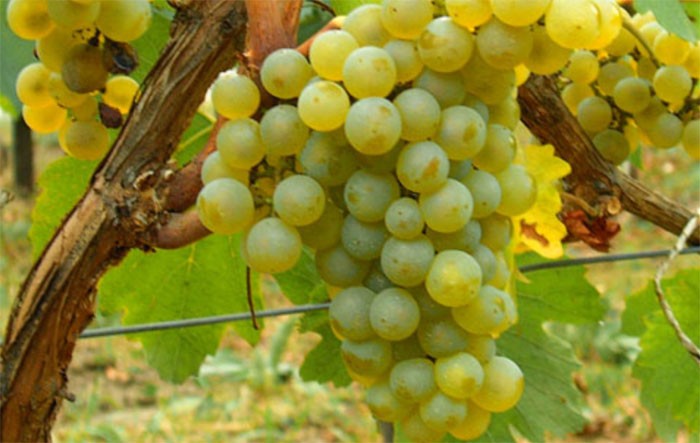
Fermentation of white wine grapes
White wine grapes must be excluded from air contact as soon as crushed to prevent the grapes from discolouring due to oxidation. Wine oxidation can occur at several stages of winemaking, but as we get closer to bottling, its consequences are more negative, so prevention plays a vital role throughout the production and storage of white wine.
Step 1: Crush the grapes in a destemmer and add an amount of potassium metabisulphate according to the quantity of grapes in the table here.
Must/ Wine | 10ppm | 20ppm | 25ppm | 30ppm | 40ppm | 50ppm | 75ppm | 100ppm |
.397 litres | .07 ml | .13ml | .16 ml | .20 ml | .26 ml | .33 ml | .49 ml | .65 ml |
.758 litres | .13 | .20 | .26 | .33 | .52 | .66 | .99 | 1.3 |
1.895litres | .33 | .66 | .82 | .99 | 1.3 | 1.6 | 2.5 | 3.3 |
3.79 l | .66 | 1.32 | 1.6 | 2.0 | 2.6 | 3.3 | 4.9 | 6.6 |
7.58 | 1.3 | 2.6 | 3.3 | 3.9 | 5.3 | 6.6 | 9.9 | 13.1 |
11.37 l | 2.0 | 3.9 | 4.9 | 5.9 | 7.9 | 9.9 | 14.8 | 19.7 |
15.16 l | 2.6 | 5.2 | 6.6 | 7.9 | 10.5 | 13.1 | 19.7 | 26.3 |
18.95 l | 3.3 | 6.6 | 8.2 | 9..9 | 13.1 | 16.4 | 24.6 | 32.9 |
37.91 l | 6.6 | 13.1 | 16.4 | 19.7 | 26.3 | 32.9 | 49.3 | 65.7 |
94.75 l | 16.4 | 32.9 | 41.1 | 49.3 | 65.7 | 82.1 | 122.2 | 164.3 |
189.5 l | 32.9 | 65.7 | 82.1 | 98.6 | 131.4 | 164.3 | 264.4 | 328.6 |
*The volumes assume 100 percent purity of the potassium metabisulphate (KBMS) and full strength of the stock solution.
You can calculate the amounts needed for any given quantity of must by summation of the values in the table above.
e.g. 40 litres of wine = 37.9 @ 50ppm = 32.9ml
+ 1.895l @ 50ppm = 1.6 ml
+ .397l @50ppm = .33ml
Total = 35ml approx
I add this to the must in smaller quantities using a pipette as soon the must quantity justifies it.
This stops oxidation of the juice and kills any natural yeast present so you then get to decide which yeast will colonise your must.
You can calculate the amounts needed for any given quantity of must by summation of the values in the table above.
e.g. 40 litres of wine = 37.9 @ 50ppm = 32.9ml
+ 1.895l @ 50ppm = 1.6 ml
+ .397l @50ppm = .33ml
Total = 35ml approx
I add this to the must in smaller quantities using a pipette as soon the must quantity justifies it.
This stops oxidation of the juice and kills any natural yeast present so you then get to decide which yeast will colonise your must.
Saigner & Cold Soak
After de-stemming and crushing, and adding potassium metabisulphate to the juice according to the chart above.
Keep the juice (must) at a temperature of below 20 degrees celcius.
If you have difficulty reducing your must to this temperature you can place a bag of ice in the must to reduce the temperature.
Make sure the bag has no holes in it or you will end up diluting your wine as the ice melts.
Alternatively you can purchase some dry ice (frozen C02), which will act as a barrier against aceto-bacter
( vinegar bacteria) as it melts.
Various strains of yeast promote different characteristics in the resulting wine.
I use a general purpose wine yeast, Lalvin EC 1118, and have had great success with this as it is suitable for sparkling wines as well.
You will also need to add a yeast nutrient to the must 12 hours prior to adding the yeast. I use diamonium phosphate at the rate of 1 .5 gms
per 4.5 litres of wine.
This supplies the must with nutrients essential for the growing yeast.
Without it you stand the chance of having an unhappy yeast and possibly a "stuck" fermentation.
Primary Fermentation
Ideally the temperature of the must needs to be brought up to about 20C before adding the yeast.
To achieve this in some areas, you may need to place an aquarium heater in your must
and regulate the thermostat to achieve a temperature of 20C.
We are now ready to re hydrate the yeast.
To do this I add equal parts of warm water at 38-40C ( not above 43 or below 35) and juice from the must
to make a quantity of liquid equal to 5 to 10 times the weight of the dry yeast to be re hydrated.
I use .25 gms of yeast per litre of must.
SO in a must of 40 litres I re hydrate 10 gms of yeast in 100ml of liquid ( 50 ml Water +50 ml of must).
Sprinkle the yeast on top of the liquid in a shallow plastic container and stir evenly until you get an even creamy liquid.
The surface area of the liquid is important to allow the liquid to cool at the correct rate.
Leave the yeast re hydrating in the liquid for about 20minutes then check the temperature.
It should be no higher than 30 0.
Before adding the yeast to your must check the temperature.
It should be no more than about 10C different to that of the must.
This allows the yeast to be introduced without a temperature shock that could affect the viability of the yeast.
When you are ready, pour the yeast liquid into the must and stir in evenly.
Remember to keep the must at about 20C to allow the colonisation rate of the yeast to be at an optimum. You must keep your fermenting juice air free with an airlock to prevent oxidisation.
As the fermentation gets underway, the must will give off carbon dioxide which will protect the wine from oxidization as CO2 is heavier than oxygen. With white wine, it is always best to keep your fermentation under an airlock to minimise the chance of oxidisation.
Follow the progress of the sugar conversion to alcohol regularly with your hydrometer.
As the sugar in the grapes is converted to alcohol, the hydrometer reading will drop from say 1.100 at the start to 1.000 at the finish
and even lower 0.992-0.995.
Until it reaches this level it is not fully fermented so be patient.
Small residual sugar levels (3-5%) will result in a sweeter wine.
You can use the calculator here to see how your wine is progressing.
Stuck Fermentation
Should a fermentation "stick" or cease before completion, it is difficult to restart.
The problem usually occurs due to temperatures being too high during fermentation or to insufficient yeast nutrients.
I have recommended keeping the must temperature at 20C Celsius prior to introducing the yeast.
Once fermentation gets under way you will find that the temperature will rise naturally with the activity of the yeast.
You should withdraw the heater if you are using one and monitor the temperature of your must at least daily.
Higher temperatures than 25C could cause your fermentation to stick.
If your fermentation sticks, the following procedure is recommended:
Cool or heat your must to 20C.
Add a fresh, actively growing yeast starter ( Red Star Premier Cuvee is particularly known for its reliability in restarting a stuck fermentation)
Add a yeast nutrient
At the time of re-inoculation, aerate the must by stirring or pumping over two to three times daily for 1 to 2 days.
Fermentation should resume.
If after several days fermentation has not restarted, try a second re-inoculation with 20% of the must and gradually double this in stages until the full must is fermenting properly.
Aging and Racking
When your ferment has finished and the hydrometer is reading at a level of 1.00 or below, your air lock should now be stable and not emitting any further CO2.
Rack the wine off the dead yeast by placing a syphon to within 2 cm of the yeast layer at the bottom of the fermenter. Syphon the wine off the lees and replace the air lock. You will need to exclude air from your wine, so it is handy to have containers of an appropriate size so the wine is within 2.5 cm of the neck.
Cold Stabilisation
Leaving your wine to stabilise at a temperature of 12 C or less over the winter monthswill cause the potassium bitartrate ( a product of the reaction between potassium and tartaric acid in the wine) to precipitate out,clarifying the wine to a certain extent and making the wine more stable once it is removed.The wine needs to be racked at least 2 more times before considering whether to fine it before bottling.Keep the temperature of the wine as cool as you can and stable so that the maximum amount of potassium bitartrate will drop out.You can then rack the wine of this and clarify it even further.If the wine is not racked, the formation of tartrate crystals when the wine is cooled before serving will make the crystals drop out and present a not so good looking wine in the glass.I have recently purchased a Buon Vino Wine filter.For quantities up to 30 litres, this machine makes a special job of filtering the wine in 2 stages. Quantities of 60 litres or more put a bit too much strain on thie small motor in this piece of equipment.For more information visit the Australian retailer's site (Ibrew from Queensland).If you use this machine you will need to purchas e a supply of No2. (medium) and No 3( fine) filter pads, as they are not always readily available when you want them.
Making Sparkling Wine
Once you have gained a little experience in the winemaking process, you may widh to undertake the challenge of making a sparkling wine. In a cool climate district this requires grapes of a lower degree of ripeness, so in most years you will achieve this before wasps or changing weather patterns stop you from making an acceptable table wine with an alcoholic level of 13.5% or more. See here for instructions on how to make a sparkling wine.