Seafood
Cooking Seafood
Tips for Fresh, Flavourful ResultsSeafood is a staple of Australian cuisine, offering a diverse range of flavours and textures. The key to cooking delicious seafood begins with proper preparation.
Always select the freshest catch when shopping for seafood—look for bright, clear eyes on whole fish, firm flesh, and a clean ocean scent. Store seafood in the coldest part of your fridge and use it as soon as possible.Before cooking, rinse seafood under cold water and pat it dry with paper towels.
Remove scales, bones, and shells as needed.
For shellfish, ensure they are alive before cooking—discard any open mussels or clams that don’t close when tapped.Cooking methods vary depending on the type. Grilling and barbecuing bring out natural sweetness, especially in prawns and fish fillets.
Steaming is ideal for delicate shellfish, while pan-frying creates a crisp crust.
Always avoid overcooking, as seafood cooks quickly and can become tough.
Seafood differs from red meat. The best result is obtained by gently cooking the flesh until it turns white.
The flavour in seafood is within the cells and if these are broken by overcooking, you lose the flavour.
A squeeze of lemon and a sprinkle of fresh herbs will enhance natural flavours.
Serve immediately for the best taste and texture.With careful preparation and attention to detail, anyone can create mouth-watering seafood dishes at home.
Preparation
If you are fortunate enough to catch fish, you are most likely used to scaling and filleting the fish in preparation for cooking.
To prepare boneless fish fillets from fish such as Bream, Snapper ,Trevally, you will need a very sharp filleting knife, preferably with a long, thin flexible blade that is able to follow the contour of the bone structure closely without leaving flesh on the fish skeleton.
Remove all scales from the fish using a scaling tool or a knife if you don't have one.
There is no need to remove the internal organs of the fish before filleting, as proper filleting will remove the flesh without rupturing the internal organs. Scale the fish and rinse in salt water to remove the scales. We don't want the knife slipping on scales it encounters.
Filleting for right handers:
With the fish belly on your left and the head pointing away from you. Make a strong cut along the backbone of the fish down to the tail. The knife , if it is sharp enough, will cut easily into the flesh.
Work the knife along the bone structure . At the tail end work the knife across the skeleton until it emerges at the anal cavity.
Work the knife through to the tail and severe the skin so that this part of the fillet is now free. Make a cut around the gill case from just behind the pectoral fin to the place you initially started.
You can then work the knife from the dorsal fins across the rib cage to produce a nearly bone-free fillet.
Turn the fish over and around to repeat the procedure on the other side.
To remove the little bones that run from the rib cage outwards to the flesh, (pin bones) feel these bones with your finger and make a cut either side of them as shown in the photos below.
This procedure takes a great deal of practice to get a very neat fillet without loosing any of the edible flesh.
Filleting fish this way reduces the weight to about 50% of whole fish weight. You need to bear this in mind when buying fresh fish. Boneless fish fillets will usually cost at least twice as much as whole fish per kg.
Flathead is filleted differently, as the rib structure on these makes it difficult to retrieve 50% without incorporating the rib bones.
Flathead caught in Tasmanian waters must now be brought ashore whole. Unfortuanately this restriction has been introduced because too many under sized flathead were being caught and filleted at sea, making it difficult for inspection authorities to verify the fish was of legal size when killed.
Fresh Fish Recipes
Recipe for frying fresh fish fillets
Ingredients:1. 2 Fillets of fish for frying ( see preparation photos below)2. 1 tablespoon Rice Flour3. 1 /2 tspoon of chopped dried dill4. 1 raw egg 5. 5 drops of Tabasco pepper sauce6. 2 tblspoons of Olive oil for shallow frying.7. A shallow bowl in which to beat the egg and a flat plate to coat the fish with Rice Flour.Method:Prepare fish fillets for frying by removing pin bones shown below.If the fish has been frozen with skin on, which assists the prevention of rapid dehydration,Skin the fillets by using a sharp knife. Start at the tail end and work the knife against the skin whist holding the tail skin.
Cooking fish with skin on often results in the fillet buckling when placed skin side to the heat. I usually skin fillets for this reason.
Place fillet on a cutting board
Feel the pin bone line with your finger and cut through the skin either side of the bone line.
Cut through the mid line of the fillet.
Place Rice Flour on a flat plate and mix in the dill, or mix in a plastic bag by shaking fillets within the bag containing flour and dill.
I use rice flour as it is gluten free and does not make your hands messy when working with it.Coat fish fillets both sides with Rice Flour.Crack the egs into a bowl and add Tabasco. Beat the egg.Heat a frying pan ( heat 7 is enough) and add the olive oil.When the oil is just smoking, dip each fillet in egg and add to the pan, skin side up. This is important, if you have not previously skinned the fillets as they will curl if the skin side is placed to the heat first.Turn fillets after 4 minutes. Cook a further 3 minutes and remove from the pan to a plate lined with paper towel.Serve with lemon wedges.
Recipes
Mussels
Fresh mussels would have to be one of my favourite seafood dishes.
When I was young we were able to readily gather fresh mussels from rocks and pier pylons where I lived.
Unfortunately too many people used rakes to over harvest and now the mussels do not grow large enough before they are enthusiastically harvested.
Mussels in shell for the table weigh in at about 25 av to the Kg. A Kg of fresh mussels will cost between $8 & $10.
Mussel & Bream Poached in Tomato
Southern Bream is not easy to buy in fish shops or in fact any commercial outlet now. So you can substitute any firm-fleshed mild flavoured fish ( Ling, Barramundi, Leather Jacket.) I would not use this recipe with high flavoured fish such as Flathead, King George Whiting, Snapper, John Dory etc.
Ingredients:
2 tblspns olive oil
50 ml white wine ( splash)
3 tomatoes chopped to 8 pieces each
2 tblspns tomato paste
2 cloves of garlic minced
1 loose handful of fresh basil leaves ( subs 1 tspn of dried basil)
1 tblspn fresh parsley ( 1 tea spoon dried)
1 dried chilli ( seeds removed)
250 gms frozen mussels ( shells removed)
3 skinned fillets of bream ( deboned and cut into pieces)
Salt/pepper grind to taste.
Method:
Place the oil in a heavy casserole base. Add garlic basil, chilli. Gradually heat until tomato starts to break up. Add tomato paste.
Simmer stirring occasionally until tomato is soft.
Add mussels and wine.
When mussels are thawed, add fish pieces.
Simmer gently until fish turns white.
Remove heat and serve with crusty bread of potato wedges to dip.
Mussel and Prawn Poached in TomatoIngredients:1 tblspn Olive oil4 cloves garlic crushed1 onion finely chopped1 chilli seeds removed300 gms prawns shelled100 gms mussels shelled2 cups seafood stock made with prawn shells1/2cup white wine2 stalks lemongrass – bottom white part crushed
Method:Heat oil in pan. Introduce garlic & onion. Cook on medium heat until onion is clear.Add prawn stock, wine, tomato & lemon grass. Cook until flavours are blended.Add prawns and mussels and cook a further 5 minutes on medium heat.Serve into bowls with crusty bread. Cooking time 15 mins.Serves 2
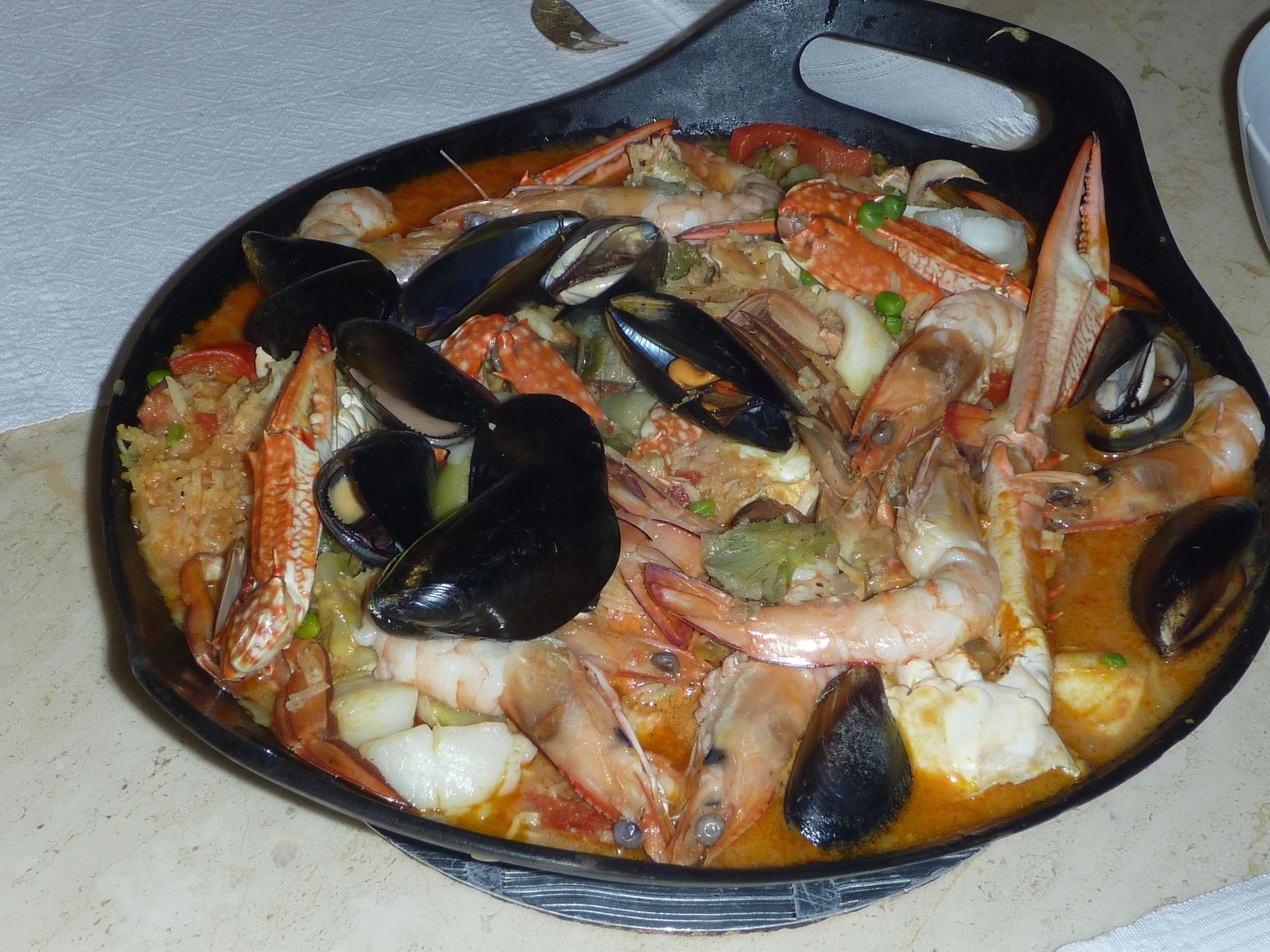
Seafood Risotto (Serves 6-8)
Ingredients:
1kg fresh firm flaked fish ( Bream, Snapper, Trevally, Ling, Flathead)
12 fresh mussels
1/kg fresh prawns shelled, tail on.
2 litres fish stock (Use the recipe for fish stock on this site)
Crab pincers for decoration if you can acquire them.
10 drops tabasco sauce
pinch of saffron threads
I cup dry white wine2 tbsp of butter1 onion, finely chopped1 1/3 cups Aborio rice1 tbsp olive oil4 medium garlic clove minced
3 tbsp Parmesan cheese, grated
1 tsp Italian herb mix3 tbsp parsley, finely chopped
Salt & Pepper to taste
MethodHeat the stock in a pot until it is simmering, and then leave it over a low heat.Put the saffron into the wine and leave it to soak.Melt the butter in a large deep heavy based casserole pot, then gently cook the onion, the garlic and tabsaco sauce until it is soft but not browned. Add the rice, turn the heat to low and stir well to coat all the grains of rice in the butter.Add the wine and saffron to the rice; turn the heat up to medium and cook, stirring the rice, until all the liquid has been absorbed. Add the hot stock, a couple of ladles at a time, stirring continuously so that the rice cooks evenly and releases some of its starch.
Add the seafood at this stage, ensuring it is mixed through to cook on the heat of the rice. Place the mussels on top.
Cover the cooking mixture until the mussels have opened.Once all the stock has been added to the rice, taste the rice to see if it is al dente. Stir in 2 tablespoons of parmesan and 2 parsley of parsley.
Serve immediately.
Seafood Risotto
OYSTERS
Long before European arrival, the Palawa people of Lutruwita sustainably harvested Angasi flat oysters and cooked them over hot coals. Ancient shell deposits, or middens, still mark traditional harvesting sites along the coasts of Tasmania. Oysters were cooked over hot coals, resulting in a firm earthy texture.
I have always loved fresh oysters, having been introduced to the Angasi oyster which grew in the sands of Corio Bay in Victoria, until they were exploited by the European settlers in the mid 1800's..
The Pacific Oyster ( Crassostrea gigas) was introduced to Tasmania by the CSIRO in 1947, The species thrived in Tasmania's clean, cold waters, eventually becoming the dominant commercial variety.
Over the past 40 years this oyster has overcome the stigma the Sydney Rock Oyster industry placed upon it, when Pacific oysters were seen as inferior. This stigma evolved , I am sure, to protect the Sydney Rock Oyster industry from competition in view of the fact that the Southern rock oyster reaches maturity in half the time of its NSW cousin. The industry in Tasmania has transitioned into a world leader in aquaculture technology.
In 2016, a disease, Pacific Oyster Mortality Syndrome (POMS) decimated stocks, killing millions of oysters. The industry recovered within 3 years through proactive breeding of POMS-resistant oysters.
Currently oysters can be bought freshly harvested in the shell from outlets along the east coast or bought, shucked, from most fresh seafood outlets.
The recipes following are recipes I have tried and adapted over my 30 years in Tasmania.
Enjoy!
Oysters Prosciutto Kilpatrick
Serves 5 as entrée.
2 1/2 dozen Pacific Oysters in ½ shell.
In a bowl place:4 tablespoons Worcestershire sauce2 teaspoons tomato sauce2 teaspoons finely chopped parsley1 teaspoons finely cracked black pepper4 slices prosciutto finely choppedMix well.Spoon prosciutto mixture on top of 2 ½ dozen oysters (in ½ shell)Cook under preheated grill until prosciutto is almost cooked.Sprinkle grated parmesan cheese on each oyster and complete grilling until cheese is melted.Place on serving plate and serve with lemon slices.